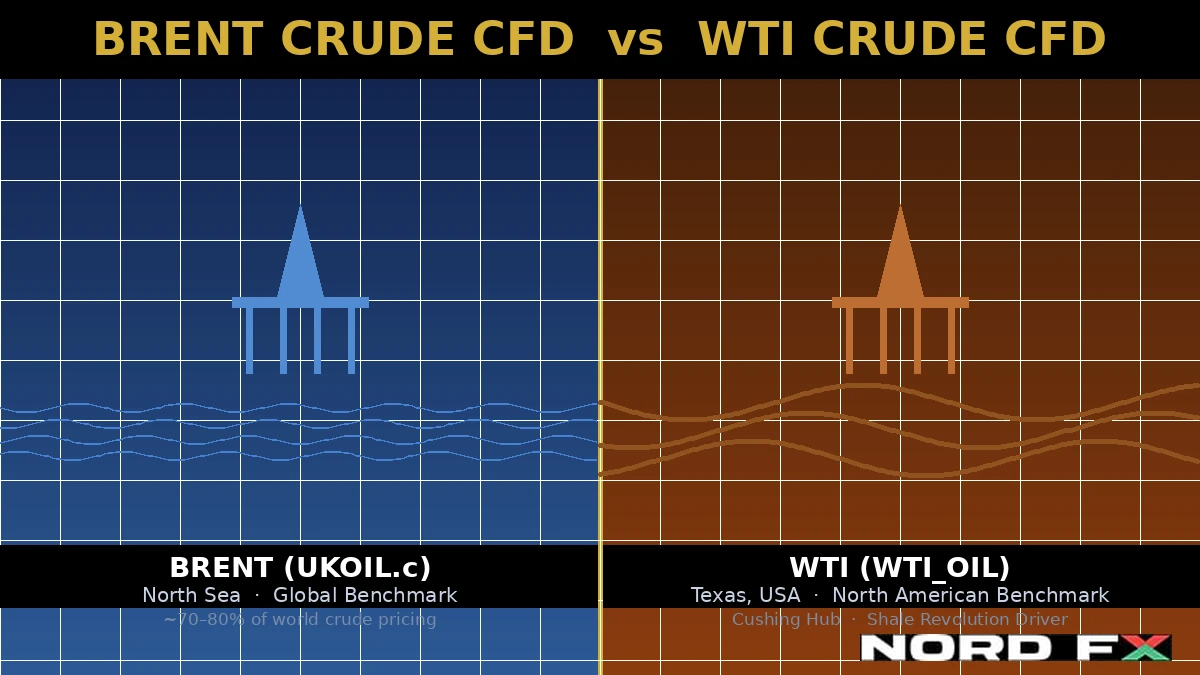
Que sont les CFD sur le Brent et les CFD sur le WTI ? Ce sont tous deux des contrats sur différence basés sur les deux références pétrolières les plus négociées au monde, permettant aux traders de spéculer sur les mouvements du prix du pétrole — à la hausse comme à la baisse — sans jamais posséder un seul baril de brut physique. Chez NordFX, ces instruments sont cotés sous les noms UKOIL.c (Brent) et WTI_OIL (West Texas Intermediate), disponibles sur tous les types de comptes – du compte MT4 Pro d’entrée de gamme aux comptes Zero basés sur l’ECN.
Le pétrole est l’un des marchés de matières premières les plus liquides et les plus volatils au monde. Comprendre la différence entre ses deux principales références — et savoir comment les trader — constitue le point de départ d’un véritable avantage.
Qu’est-ce qu’un CFD sur le Brent ?
Le Brent tire son nom du champ pétrolier de Brent, en mer du Nord, développé dans les années 1970 entre le Royaume-Uni et la Norvège. Il est classé comme léger et doux — faible densité, faible teneur en soufre — ce qui le rend moins coûteux à transformer en essence, diesel et kérosène.
Le Brent est la référence mondiale : il sert à tarifer environ 70 à 80 % du pétrole brut échangé à l’international, couvrant les approvisionnements d’Europe, d’Afrique et du Moyen-Orient. Lorsque les prix du pétrole apparaissent dans l’actualité financière internationale, il s’agit presque toujours du Brent.
Chez NordFX, le Brent se négocie sous le symbole UKOIL.c, avec un lot standard représentant 100 barils. Comme le Brent reflète la dynamique mondiale de l’offre et de la demande — décisions de production de l’OPEP+, géopolitique au Moyen-Orient, principales routes maritimes comme le détroit d’Ormuz — il réagit fortement aux gros titres internationaux. Pour les traders qui suivent les événements macroéconomiques mondiaux, cela en fait un instrument très réactif.
Qu’est-ce qu’un CFD sur le WTI ?
Le West Texas Intermediate (WTI) est la référence américaine, produit principalement dans le bassin permien au Texas et dans le sud de l’Oklahoma. Son centre de cotation est le terminal de Cushing, en Oklahoma — un nœud de stockage et de pipelines enclavé à l’intérieur des États-Unis.
Le WTI est légèrement plus léger et plus doux que le Brent, avec une teneur en soufre encore plus faible, ce qui le rend idéal pour le raffinage en essence. Il constitue la principale référence des prix du pétrole en Amérique du Nord.
Chez NordFX, le WTI se négocie sous le symbole WTI_OIL, également avec un lot standard de 100 barils. Le prix du WTI est particulièrement sensible aux données domestiques américaines : les rapports hebdomadaires de l’EIA sur les stocks de pétrole publiés chaque mercredi, les volumes de production du schiste américain, les taux d’utilisation des raffineries et les décisions de la Réserve fédérale qui influencent le dollar américain.
Brent vs WTI : les principales différences
Bien que les deux références soient étroitement corrélées — montant et baissant ensemble lors des grands événements mondiaux — elles ne sont pas identiques, et l’écart entre elles, le spread Brent-WTI, peut lui-même constituer un signal utile.
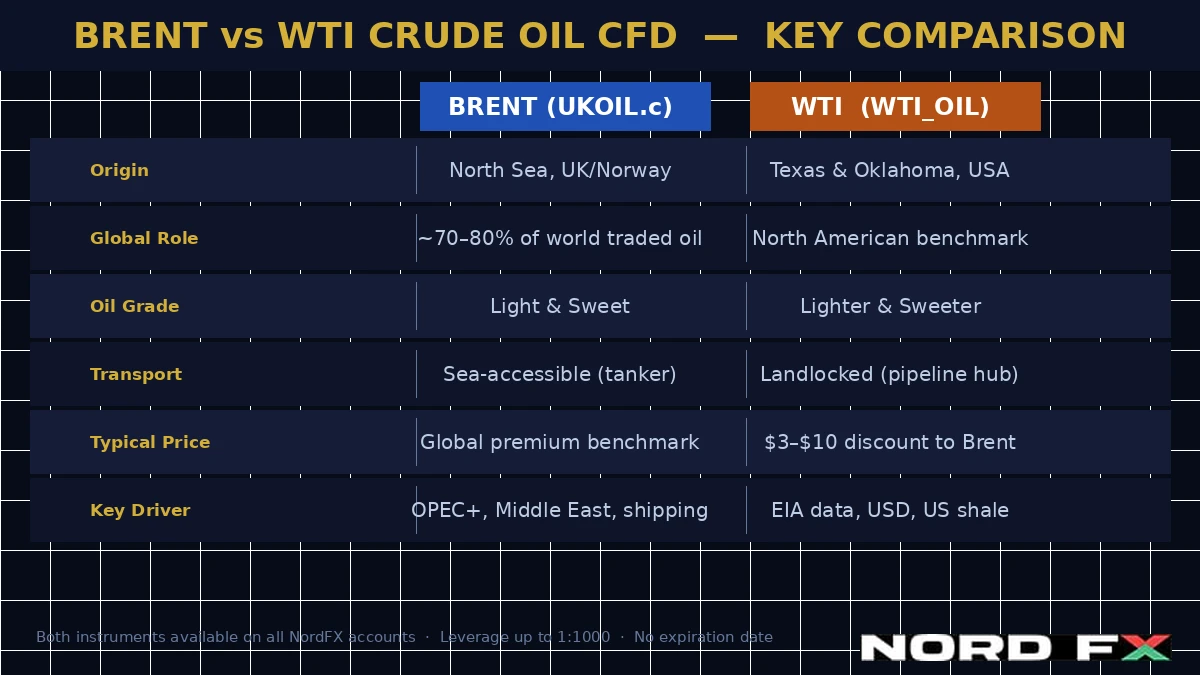
Origine et accessibilité. Le Brent est produit au large et peut être facilement expédié dans le monde entier par pétrolier. Le WTI est enclavé au Texas, ce qui a historiquement créé des goulets d’étranglement de stockage et de transport, lui valant une décote structurelle par rapport au Brent.
Sensibilité mondiale vs régionale. Le Brent réagit davantage aux évolutions internationales : réunions de l’OPEP+, conflits armés au Moyen-Orient, perturbations des grandes voies maritimes. Le WTI réagit davantage aux données spécifiques aux États-Unis — rapport hebdomadaire sur les stocks de l’EIA, production domestique de schiste et indice du dollar américain.
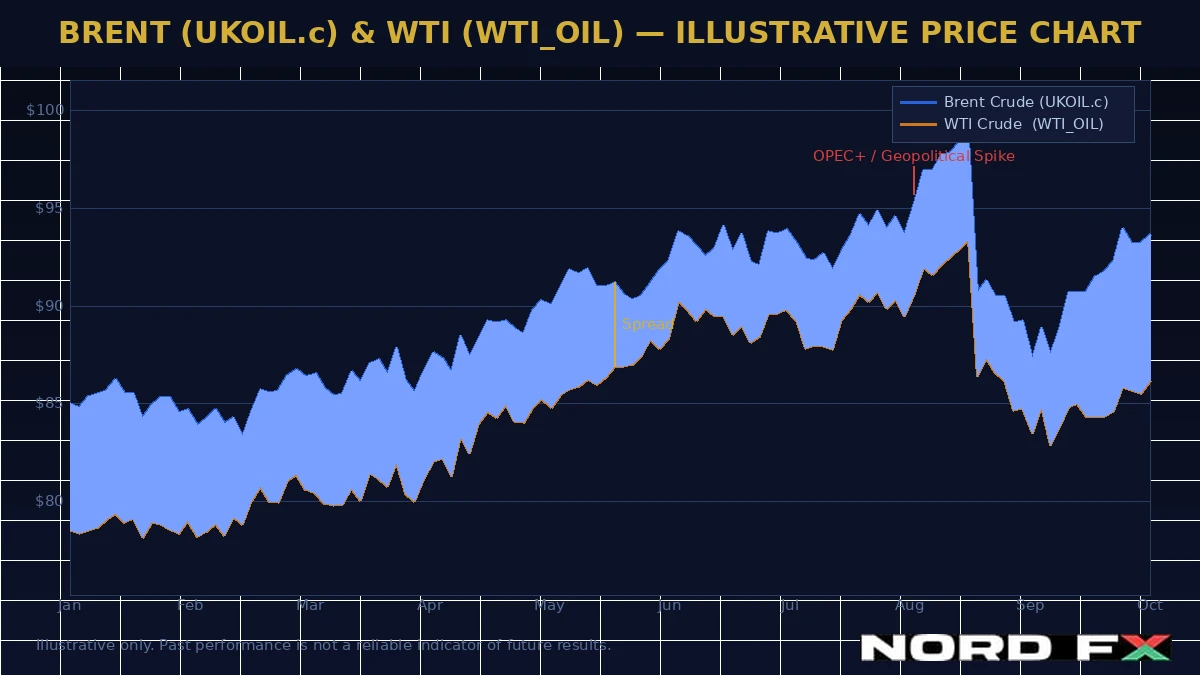
Le spread de prix Brent-WTI. Historiquement, le Brent se négocie avec une prime d’environ 3 à 10 dollars par baril sur le WTI. Avant 2010, le WTI s’échangeait en réalité au-dessus du Brent. L’écart s’est ensuite fortement creusé, atteignant près de 23 dollars en août 2012, alors que la révolution du schiste américain inondait les marchés domestiques de brut qui ne pouvait pas facilement atteindre les acheteurs mondiaux. Une prime Brent en hausse signale souvent une inquiétude sur l’offre internationale ; un spread qui se resserre peut indiquer une faiblesse de la demande américaine.
Quelle référence convient à quel trader ? Les traders axés sur les événements macro mondiaux préfèrent souvent le CFD sur le Brent (UKOIL.c). Les traders qui suivent les données économiques américaines et la politique de la Réserve fédérale trouvent souvent le CFD sur le WTI (WTI_OIL) plus réactif. De nombreux traders expérimentés détiennent des positions sur les deux simultanément, en utilisant le spread comme couche d’analyse supplémentaire.
Qu’est-ce qui détermine les prix du pétrole ?
Les décisions de l’OPEP et de l’OPEP+ sont le moteur récurrent le plus puissant. Les réductions de production font monter les prix ; la surabondance les fait baisser. Ce sont des événements programmés que les traders anticipent à l’avance.
Le risque géopolitique compte surtout pour le Brent. Les conflits ou l’instabilité dans les grandes régions productrices — Moyen-Orient, Russie, Afrique de l’Ouest — peuvent provoquer des hausses rapides des prix, les marchés intégrant les perturbations de l’offre avant même qu’elles ne se produisent.
Les données sur les stocks américains influencent surtout le WTI. L’EIA publie son Weekly Petroleum Status Report chaque mercredi. Une hausse des stocks supérieure aux attentes fait généralement baisser le WTI ; un retrait des stocks le fait monter.
Le dollar américain. Le pétrole est coté mondialement en dollars. Un dollar plus fort rend le pétrole plus cher pour les acheteurs utilisant d’autres devises, ce qui freine la demande et pèse sur les prix. Un dollar plus faible les soutient — ce qui rend la politique de la Réserve fédérale indirectement pertinente pour tout trader de CFD sur le pétrole.
La croissance macroéconomique. La demande de pétrole suit de près la production industrielle. Une forte croissance du PIB en Chine, aux États-Unis ou en Inde soutient les deux références ; les récessions et les ralentissements manufacturiers produisent l’effet inverse.
Comment trader les CFD sur le Brent et le WTI chez NordFX
Étape 1 : Choisissez votre compte. Tous les comptes NordFX donnent accès à UKOIL.c et WTI_OIL. Le compte MT4 Pro est un point de départ pratique, avec un dépôt minimum de seulement 10 $. Les traders recherchant des spreads plus serrés et une exécution ECN peuvent ouvrir un compte MT4 Zero ou MT5 Zero à partir de 100 $ et 200 $ respectivement, avec un effet de levier allant jusqu’à 1:1000. Si vous débutez dans le trading de CFD sur le pétrole, ouvrez d’abord un compte démo gratuit — il reproduit exactement les conditions du marché réel, avec des fonds virtuels, afin qu’aucun capital ne soit en danger pendant votre apprentissage.
Étape 2 : Ouvrez MetaTrader et repérez l’instrument. Dans le panneau Market Watch, trouvez UKOIL.c pour le Brent ou WTI_OIL pour le WTI. Faites un clic droit sur l’un ou l’autre symbole pour ouvrir un graphique, ajouter des indicateurs techniques ou accéder directement à la fenêtre d’exécution des ordres.
Étape 3 : Analysez le marché. Déterminez si vous pensez que les prix vont monter (long/achat) ou baisser (short/vente). Utilisez les outils techniques intégrés de MetaTrader — moyennes mobiles, RSI, MACD, bandes de Bollinger — et restez informé grâce à l’analyse hebdomadaire du marché NordFX, qui couvre chaque semaine le Brent ainsi que les principales paires de devises et matières premières, en vous donnant à la fois la perspective technique et les événements macro clés à surveiller.
Étape 4 : Définissez la taille de votre position et vos contrôles de risque. Un lot standard équivaut à 100 barils. Placez toujours un Stop Loss avant d’ouvrir une position sur CFD pétrole. Un ordre de Take Profit verrouille automatiquement les gains à votre objectif. Risquer plus de 1 à 2 % du capital du compte par trade est l’erreur la plus fréquente chez les nouveaux traders pétrole — et l’effet de levier permet de dépasser facilement cette limite sans s’en rendre compte.
Étape 5 : Exécutez, surveillez et clôturez. UKOIL.c et WTI_OIL se négocient presque 24 heures sur 24, cinq jours par semaine. Contrairement aux contrats à terme, les CFD pétrole NordFX n’ont pas de date d’expiration fixe, vous clôturez donc la position lorsque votre analyse vous indique de le faire.
Un exemple pratique
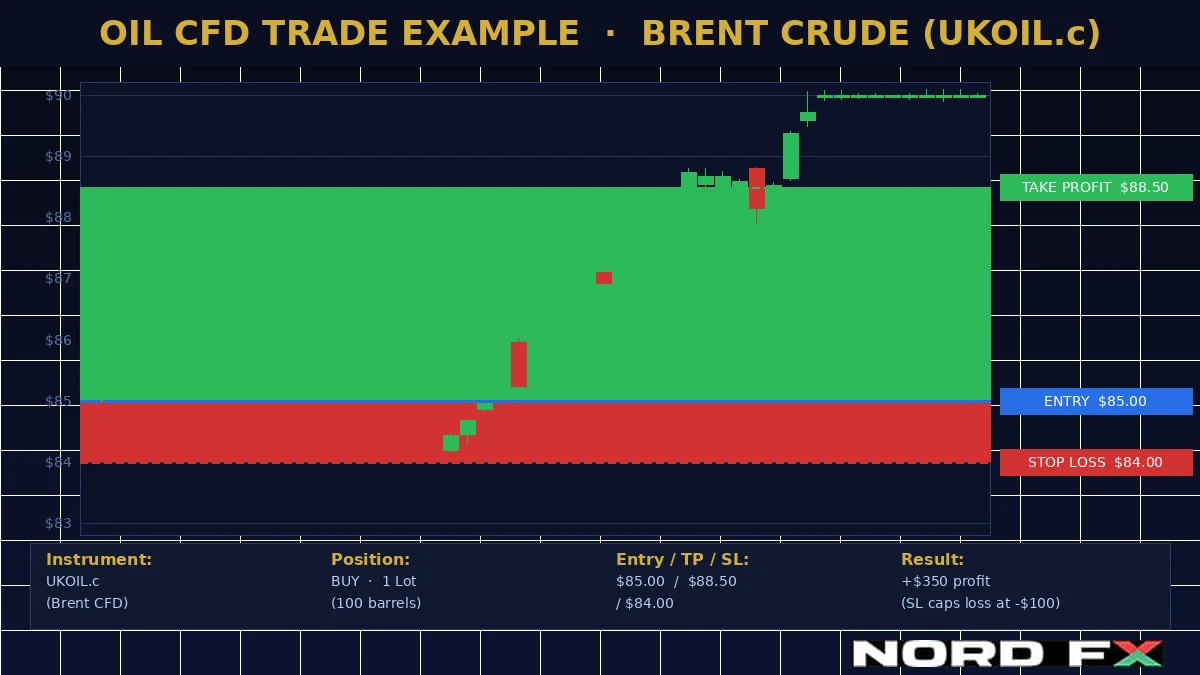
Le Brent (UKOIL.c) se négocie à 85,00 $. Vous pensez qu’une prochaine réunion de l’OPEP+ aboutira à une réduction de production et ouvrez une position achat d’1 lot (100 barils). Le prix monte à 88,50 $ et vous clôturez le trade. Profit brut : variation de 3,50 $ × 100 barils = 350 $.
Si les prix avaient chuté à 83,00 $ sans Stop Loss en place, la perte aurait été de 200 $. Si votre Stop Loss avait été fixé à 84,00 $, la perte aurait été limitée à 100 $, quel que soit le mouvement ultérieur du prix. C’est pourquoi la gestion du risque n’est pas optionnelle — c’est le fondement structurel de toute stratégie durable de CFD pétrole.
Erreurs courantes lors du trading de CFD sur le pétrole
Ignorer le spread Brent-WTI. Lorsque les deux instruments divergent fortement, un événement régional influence généralement l’un mais pas l’autre. Les traders qui les traitent comme identiques interprètent souvent mal la force réellement dominante.
Trader à l’aveugle autour des publications clés. Les chiffres de stocks de l’EIA et les communiqués de l’OPEP peuvent faire bouger les prix du pétrole de plusieurs dollars en quelques secondes. Entrer en position juste avant de tels événements sans vision directionnelle relève de la spéculation, pas du trading.
Utiliser un effet de levier excessif. NordFX offre un levier allant jusqu’à 1:1000. Utiliser une grande partie de ce levier sur des positions pétrole qui évoluent ensuite contre vous — même légèrement — peut rapidement anéantir un compte. La plupart des professionnels considèrent la préservation du capital comme leur objectif principal et n’utilisent qu’une fraction du levier disponible.
Ignorer les frais de swap nocturnes. Les CFD sur NordFX entraînent des frais de financement pour les positions conservées au-delà de la journée de trading. Pour UKOIL.c et WTI_OIL, les frais de stockage sont de 25 $ par jour et par lot à partir du 6e jour, triplés le vendredi. Les positions de plusieurs semaines supportent des coûts de portage qui doivent être intégrés à la rentabilité avant l’ouverture du trade, et non après.
Questions fréquemment posées
Quelle est la différence entre un CFD sur le Brent et un CFD sur le WTI ? Le Brent (UKOIL.c) suit le pétrole de la mer du Nord — la référence mondiale pour environ 70 à 80 % du brut échangé internationalement. Le WTI (WTI_OIL) suit la référence domestique américaine. Les deux sont corrélés mais réagissent différemment aux événements régionaux, et le Brent se négocie généralement avec une prime de 3 à 10 dollars par baril.
Puis-je trader en même temps le Brent et le WTI sur NordFX ? Oui. Les deux instruments sont disponibles simultanément sur tous les comptes NordFX. De nombreux traders détiennent des positions sur les deux afin de diversifier leur exposition au pétrole ou de trader le spread entre les deux références.
Quel est le dépôt minimum pour commencer ? Le compte MT4 Pro démarre à partir de 10 $. Les comptes MT4 Zero et MT5 Zero exigent respectivement 100 $ et 200 $, avec exécution ECN et spreads à partir de 0,0 pip.
Les CFD pétrole sur NordFX expirent-ils comme les contrats à terme ? Non. Les CFD pétrole NordFX n’ont pas de date d’expiration fixe. Les positions restent ouvertes tant que la marge est suffisante — ce qui est plus simple à gérer que les contrats à terme pour la plupart des traders particuliers.
Quel est le meilleur moment pour trader les CFD pétrole ? La liquidité atteint son pic pendant le chevauchement des sessions européenne et américaine, soit environ de 13:00 à 17:00 GMT. Le rapport hebdomadaire de l’EIA, publié chaque mercredi à 14:30 GMT, génère régulièrement les plus forts mouvements intraday sur le WTI et le Brent. Les réunions de l’OPEP+ créent une volatilité tout aussi concentrée lorsqu’elles sont programmées.
Que faire ensuite : Ouvrez un compte démo NordFX gratuit, trouvez UKOIL.c et WTI_OIL dans MetaTrader, et pratiquez vos premiers trades de CFD pétrole avec des fonds virtuels. Une fois à l’aise avec le fonctionnement et muni d’une stratégie testée, passez à un compte réel et commencez à trader avec du capital réel.
Revenir en arrière Revenir en arrière