Forex and Cryptocurrency Forecast for May 25 – 29, 2026

The week of May 18–22 was defined by two forces: hawkish FOMC Minutes and a fragile diplomatic opening on the Strait of Hormuz. The April 29 FOMC Minutes (released Wednesday, May 20) confirmed a deeply divided Fed: "many participants indicated they would have preferred removing the easing bias," and a majority saw a rate hike as warranted if inflation persists. CME FedWatch now prices ~35% probability of a December rate hike, with all 2026 cuts fully priced out. On the geopolitical front, US Secretary of State Rubio acknowledged "slight progress" in Iran talks mediated through Pakistan; Tehran confirmed the latest proposal "partially bridged the gap" – yet Iran's Supreme Leader has ordered enriched uranium to remain within its borders, keeping a full deal structurally elusive. Oil futures fell more than 6% on the week as markets priced in a potential eventual deal, while the IEA reiterated that the global oil market will remain materially undersupplied through October 2026 even if the conflict ends next month. The S&P Global Eurozone Flash PMI (May 22) showed the region contracted at the fastest pace since late 2023, with input inflation near a three-year high; S&P Global warned Eurozone CPI could approach 4% in coming months. The ECB has signalled a rate hike is possible as early as its June meeting.

Macro framework entering May 25–29: Fed on hold at 3.50–3.75%; ECB hike as early as June; DXY held above 99 for a second consecutive week.

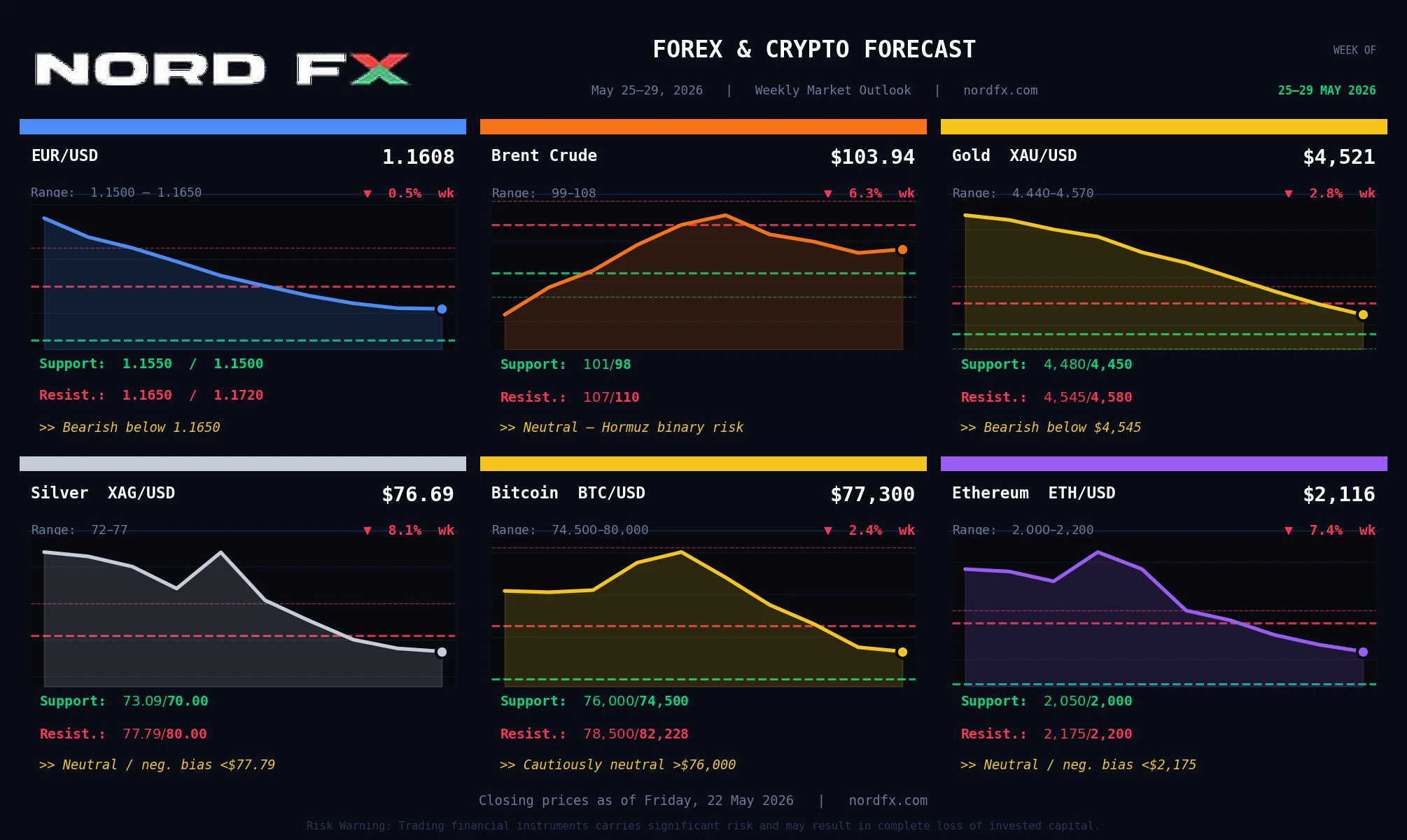
Closing prices, Friday May 22, 2026:

EUR/USD – 1.1608 | Brent Crude Oil Futures – $103.94 | Gold (XAU/USD) – $4,521 | Silver (XAG/USD) – $76.69 | Bitcoin (BTC/USD) – $77,300 | Ethereum (ETH/USD) – $2,116

Key macro calendar, May 25–29: US markets CLOSED Monday May 25 (Memorial Day). Tuesday: US Consumer Confidence & Durable Goods Orders; Germany GfK Consumer Confidence; Eurozone Economic Sentiment. Wednesday: EIA Crude Oil Inventories. Thursday: US Q1 GDP – Second Estimate (central event); Initial Jobless Claims; Pending Home Sales. Friday: US PCE Inflation (Fed's preferred gauge); Chicago PMI; Michigan Consumer Sentiment Final; Eurozone & Germany preliminary CPI. Note: FOMC pre-meeting blackout begins May 29.

NordFX_Forecast_Card_May25-29_2026

EUR/USD

EUR/USD closed at 1.1608 (Investing.com prev close 1.1621; day range 1.1588–1.1626; 52-week range 1.1210–1.2079). The pair fell for a third consecutive week, pressed by the hawkish FOMC Minutes and DXY above 99. Price is trading below both the 20-day SMA (~1.1650) and 100-day SMA (~1.1630). Investing.com technical summary: Strong Sell on all intraday and daily timeframes; RSI near 40 – approaching oversold but not yet extreme. Structurally, ECB hike expectations as early as June provide a medium-term floor.

Key catalysts: US Consumer Confidence & Durable Goods (Tue) – strong readings reinforce dollar strength and press EUR/USD toward 1.1530–1.1500. Q1 GDP second estimate (Thu) – a downside revision reopens rate-cut narrative and sparks a rebound toward 1.1680. PCE inflation (Fri) – the week's decisive trigger: hot print extends the dollar rally; cool print triggers a relief bounce. Eurozone preliminary CPI (Fri) – a reading near 4% strongly reinforces ECB hike pricing and could briefly push EUR/USD sharply higher. Thin Monday liquidity amplifies headline risk from any Iran weekend development.

Resistance: 1.1650, 1.1680, 1.1720  Support: 1.1550, 1.1500, 1.1483–1.1497

Baseline view: Bearish below 1.1650. The 200-day SMA (~1.1615) is the immediate pivot; a daily close below 1.1550 opens 1.1500–1.1483. Recovery requires a below-consensus PCE reading and/or a concrete Hormuz breakthrough. Base case: 1.1500–1.1650 range.

Brent Crude Oil

Brent settled at $103.94 (Investing.com prev close $102.58; day range $101.34–$106.36; 52-week range $58.72–$126.41), falling more than 6% on the week from the $107.00 close of May 15 as markets began pricing a potential Hormuz deal. Rubio's "slight progress" acknowledgment and Iran's partial openness to the latest US proposal drove the weekly decline. Investing.com technical rating has shifted to Neutral on the daily timeframe – a clear change from the prior "Strong Buy" – reflecting the market's transition from pure geopolitical premium toward scenario-weighted pricing.

Key catalysts: Hormuz diplomatic headlines remain the dominant driver (any day). EIA crude inventories (Wed/Thu). Q1 GDP (Thu) – a strong reading supports demand-side confidence. Eurozone CPI (Fri) – a near-4% reading would reinforce ECB hikes and indirectly reduce the dollar premium on oil. Iran escalation or confirmed deal is the tail risk in both directions.

Resistance: $107.00, $110.00, $114.00  Support: $101.00, $98.00, $95.00

Baseline view: Neutral with geopolitical binary risk. The structural supply shock (IEA: undersupplied through October; Saudi output at 36-year lows) prevents a sustained sell-off absent a confirmed deal. A confirmed Hormuz agreement triggers a $15–20 retreat toward $85–90; renewed escalation re-targets $112–$118. Base case: $99–$108 range, with directional resolution tied to Hormuz diplomacy and EIA data.

Gold (XAU/USD)

Gold (XAU/USD spot) closed at $4,521 (Investing.com: current $4,521.68, prev close $4,543.29; day range $4,507–$4,546; 52-week range $3,245–$5,595). The metal posted a −2.8% weekly decline from the $4,652 close of May 15 – a fourth consecutive week of losses. The hawkish FOMC Minutes inflated the opportunity cost of holding non-yielding gold while the USD surged; partial Hormuz diplomatic progress modestly reduced the geopolitical premium. Gold has broken below the 50-day SMA (~$4,538) and is approaching the 100-day SMA (~$4,490). Investing.com rates XAU/USD Sell on the daily timeframe. Long-term institutional targets remain elevated: Goldman Sachs $5,400, JPMorgan $5,900 year-end.

Key catalysts: PCE inflation (Fri) is the primary trigger: a hot print above consensus (~3.2% core) pushes below $4,480–$4,450; a cool print sparks a rebound toward $4,580–$4,640. Q1 GDP (Thu) – a downside revision is mildly gold-positive by reopening rate-cut expectations. Confirmed Iran deal is initially gold-negative (eases oil inflation) but medium-term positive (reopens rate-cut path). Michigan Consumer Sentiment final (Fri) – inflation expectations component closely monitored by the Fed.

Resistance: $4,545, $4,580, $4,650  Support: $4,480, $4,450, $4,400

Baseline view: Bearish to neutral below $4,545. Loss of the $4,600 floor makes $4,450–$4,480 the next major test zone. PCE Friday is the fulcrum: a hot reading extends the sell-off toward $4,400; a cool reading reverses the trend and targets $4,580+. The long-term bull case ($5,400–$5,900 analyst consensus) remains intact. Base case for the week: $4,440–$4,570, biased lower ahead of PCE.

Silver (XAG/USD)

Silver (XAG/USD) closed at $76.69 (Investing.com prev close $76.6875; day range $79.11–$80.35 earlier in the week, settling lower; 52-week range $31.64–$121.67). Silver gave back ground under the twin pressures of dollar strength and rising rate-hike expectations, with FXStreet reporting silver trading near $75.90–$76.10 during Friday's session. The 20-day EMA at $77.79 is now acting as near-term resistance, and price is struggling below the broken upward-sloping trendline from the March 23 low of $61.01. Investing.com rates XAG/USD Sell on the daily timeframe. The structural supply deficit (sixth consecutive year projected) and AI/solar industrial demand provide long-term support but little near-term price relief.

Key catalysts: PCE data (Fri) – hot print targets $72–$70; cool print triggers rebound toward $78–$80. China manufacturing PMI (Fri) – silver is acutely sensitive to Chinese industrial demand. Q1 GDP (Thu) – downside revision is mildly positive via rate-cut re-pricing. India tariff watch – any reversal of the 15% import tariff is strongly positive. EIA inventories (Wed) – rising crude inventories ease inflation fears and offer marginal silver support.

Resistance: $77.79 (20-day EMA), $80.00, $83.00  Support: $73.09, $70.00, $67.50

Baseline view: Neutral with negative bias below $77.79. The 20-day EMA and broken trendline form a combined resistance ceiling. Thin Memorial Day liquidity on Monday creates elevated gap risk on Iran weekend headlines. PCE Friday is the decisive catalyst. Base case: $72–$77 oscillation, with risk of testing $70 on a hot PCE print or Hormuz breakdown.

Bitcoin (BTC/USD)

Bitcoin closed the week at approximately $77,300 (Yahoo Finance Friday open $77,546; BTC traded within a narrow $132 range across the entire week per Yahoo Finance), a −2.4% weekly decline from $79,157. The prior week's deleveraging event ($360M in long liquidations) appears to have flushed out weak hands, with exchange reserves at 7-year lows as long-term holders accumulate. The 200-day EMA (~$82,228) has now rejected BTC for four consecutive weeks. BlackRock IBIT holds ~812,000 BTC (~$62B); cumulative ETF net inflows stand at $58.5B. The CLARITY Act (crypto market structure bill) continues to advance through the Senate Banking Committee, maintaining legislative tailwinds.

Key catalysts: PCE inflation (Fri) – a hot print revives Treasury yield pressure, threatening a move below $75,000; cool print helps BTC push toward the 200-day EMA. Q1 GDP (Thu) – downside revision is mildly BTC-positive. CLARITY Act progress – any vote or committee advancement is a major catalyst. Iran peace deal – bullish for all risk assets. Memorial Day Monday creates thin liquidity and elevated weekend headline sensitivity.

Resistance: $78,500, $80,000, $82,228 (200-day EMA)  Support: $76,000, $74,500, $72,000

Baseline view: Cautiously neutral above $76,000. The tight weekly range signals equilibrium at current levels. Record-low exchange supply and $58.5B in ETF inflows provide the structural floor. The 200-day EMA at $82,228 remains the decisive breakout level; a confirmed close above it opens $84,000–$86,000. Base case: $74,500–$80,000 range, with weekend gap risk elevated due to Memorial Day and active Iran diplomacy.

Ethereum (ETH/USD)

Ethereum closed the week at $2,116 (Yahoo Finance ETH-USD $2,115.89; 52-week range $1,388–$4,956). Like BTC, ETH traded in an exceptionally tight range – prices shifted by less than $2 across Monday–Friday openings (Yahoo Finance) – reflecting the same wait-and-see mood. ETH continues to underperform BTC: the 50-day EMA (~$2,175) and 200-day MA (~$2,200) form a tightly clustered resistance ceiling that has rejected every ETH rally in May. Investing.com rates ETH Strong Sell on all intraday and daily timeframes. Spot ETH ETF flows (BlackRock ETHA, Fidelity FETH) provide a structural floor. CLARITY Act advancement is arguably more important for ETH than BTC, directly addressing regulatory uncertainty around Ethereum's commodity vs. security classification.

Key catalysts: PCE inflation (Fri) – ETH is historically more macro-rate-sensitive than BTC; hot print targets $2,000 and potentially $1,950. CLARITY Act news – disproportionately positive for ETH. Q1 GDP (Thu) – downside revision mildly positive via rate-cut re-pricing. Any new smart contract exploit would weigh on ETH sentiment disproportionately. Iran peace deal bullish for all risk assets.

Resistance: $2,175 (50-day EMA), $2,200 (200-day MA), $2,320  Support: $2,050, $2,000, $1,950

Baseline view: Neutral with negative bias below $2,175. The tightly clustered EMA/MA resistance at $2,175–$2,200 has capped ETH for over three weeks. $2,000 is the critical psychological support; a close below it opens $1,950 and the $1,850 multi-month zone. ETH is unlikely to outperform BTC absent a CLARITY Act catalyst or surprise dovish PCE. Base case: $2,000–$2,200 range, with ETH continuing to underperform BTC in the current macro environment.

Conclusion

Two forces define the May 25–29 trading week. First, the Memorial Day US market holiday on Monday compresses the effective week to four trading days while amplifying gap risk on any Iran-related weekend headlines. Second, the week builds to its decisive macro climax on Thursday–Friday: Q1 GDP second estimate and PCE inflation data will determine whether the Fed's hawkish pivot deepens further – with direct consequences for every instrument in this forecast.

EUR/USD defends the 200-day SMA (~1.1615) under sustained dollar pressure; a hot PCE breaks it toward 1.1483–1.1497. Brent trades in a binary diplomatic regime around $103–$104: a confirmed Hormuz deal triggers a $15–20 collapse; a breakdown re-targets $112+. Gold has lost the $4,600 support zone and tests the 100-day SMA – PCE Friday determines whether $4,400 or $4,580 is next. Silver faces the 20-day EMA ($77.79) as resistance and $70 as the downside scenario on a hot PCE or Hormuz setback. Bitcoin is range-locked between $74,500 and the 200-day EMA ($82,228) – on-chain fundamentals support the floor while the macro ceiling holds. Ethereum underperforms BTC with the $2,175–$2,200 EMA/MA cluster as the resistance ceiling and $2,000 as the critical support line.

NordFX Analytical Group

Disclaimer: These materials are not an investment recommendation or a guide for working on financial markets and are for informational purposes only. Trading on financial markets is risky and can lead to a complete loss of deposited funds.

ආපසු යන්න ආපසු යන්න
මෙම වෙබ් අඩවිය කුකීස් භාවිතා කරයි. අපගේ කුකීස් ප්‍රතිපත්තිය පිළිබඳ වැඩි විස්තර දැන ගන්න.